Monday, 22 June 2015

Wednesday, 17 June 2015
Writing: Conventicle, Chapter Eight
Weiss found himself waking from a long, dreamless
sleep, into slanting sunlight in an unfamiliar room. His muddy clothes were
heaped upon the floor, strange and foreign amids the clean linen sheets, the
tall arching windows, the fluttering white drapes, and the smooth white stone
floor. Cool mountain air drifted in the windows, but Weiss was more interested
in the smells drifting in through the bedchamber’s door: rich, meaty, hearty
smells that set his stomach rumbling with an urgency that brooked no argument.
He dressed himself in a brown robe that
hung beside the bed, and despite feeling rather awkward in its loose folds, he
made his way out into the hall.
“Good morning, traveller,” said the man
from the gate last night, who was stirring pottage over a cheerful fire in the
common room. He rose to press Weiss’ hand sincerely, introducing himself as
Hallan, and then gestured him to a place at the table and served him: pottage
with red beans and mutton, thick slices of bread, cheese, and then cream and
berries, and steaming tea. Weiss ate and ate, until looking down at his place
he was suddenly quite ashamed of how much of this good man’s food he had eaten
and what poor company he had been throughout.
“Nay, nay,” said Hallan mildly when
Weiss apologized. “There’s few come through here that aren’t in need of a good
sleep and a better meal, but you looked more in need of them than most.” He
nodded in the direction of a large mirror that hung to the left of the table
and Weiss, giving his reflection the attention that had previously been fully
taken up with food, was shocked at how gaunt and dirty he looked.
“I wonder you were willing to put me in
one of your beds in this state,” he said, shaking his head.
“Sheets wash clean,” shrugged Hallan.
“And I keep the beds for travellers. Now tell me, Weiss, how came you here? Who
sent you? And what became of you on the way, that you were so worn and dirty?”
So Weiss began at the beginning, meeting
Mare on the plains, his struggle in the marsh, how Signa turned back. The man
and the mountain and the flight from the Blind Eye.
Hallan listened silently, sympathy
dancing across his face as Weiss spoke, but he interrupted once to ask, “Where
is Mare now? I’d have expected her to reach Caethron by now.”
“She said she had one more village to
visit,” said Weiss. A little knot of worry danced into the air off Hallan’s
brow, and Weiss swallowed it, and would nurse it for all the rest of the
morning and evening.
“Well, the way you’ve come by has been
the death of many, and it will be the death of many more,” said Hallan soberly
when Weiss finished his tale. “Thanks be to Elionae that you have come so far
in one piece.”
“I should never have done if not for
Mare,” said Weiss. “And I was so witless every step of the way, forgetting the
map, falling for tricks, that I am ashamed to even stand talking here. And
yet—“ he looked ‘round at Hallan earnestly—“I could not be gladder to be here.”
“Your shame need not weigh you down,”
said Hallan. “Here there is no reproach. Only help.”
Together, they passed the afternoon in
extraordinary peacefulness, drawing water from a mountain stream to warm for a
bath for Weiss, and then to wash his clothes. Standing in his room as he
readied himself to dress in his sun-dried breeches, jerkin, and cloak, Weiss
ran his palm along the strict cording of the Deedsweight where it cut into the
skin of his shoulder. Unbreakable. Everyone had always said so. Just something
to live with. And beyond through the wide stone arch of window, Caethron lay in
the valley, a little cluster of white stone houses, small amidst the crags and
grasses, and it was hope. Weiss squared his shoulders, and it was as if his
heart was running, sprinting and leaping through the open window, down, down
the rocky slope, to the village, and to what was beyond it, to the way that would
lead him—must lead him, for what else
was there?—to the Breaker of the Unbreakable Cord.
#
“They will find us, I know they will.”
Aldous said it quietly, into the scrub grass, so neither the Thron nor the farm
worker could hear. She knew she ought to sleep; it was still a few hours before
day and she could use the rest for the journey ahead. The mountains were cold,
though, and her heart was colder with fear. Vana and Cressus would’ve gone back
by now, to the spot where they had left her guarding the prisoners, and they
would’ve seen her treachery, and they would be hunting. Cressus, she thought,
might give her mercy, but Vana would not be reined in, not after this. And when
she thought of Cressus’ fierce glee, breaking the staff and binding the women
and pounding away after Weiss, she was not even sure he would give her mercy.
She shook like a leaf as she lay wrapped in her cloak, and not only for the
chill of the ground.
Yet she had not been able to say no.
Mare—that was the Thron—had asked her why she wept, and a thousand thousand
grey days had tumbled open and left Aldous’ heart bare. It was like a blind
creature from a cave, white-eyed and feeble, that husk of a heart, but Mare had
spoken balm to it. “Why stay here,” she had asked, “to steep in such misery for
the rest of your days?”
Aldous had cried. By the Queen, she had
cried harder than she could ever remember crying, till her cheeks throbbed and
the skin around her eyes was dappled red and her nose ran like a neglected
child’s, and Mare had lain patiently on the cold ground until the storm was
passed and Aldous was ready to saw the ropes loose and help Mare and Arris, the
villager, to their feet.
Her cave-creature heart had held onto
Cressus. It was still holding onto him, truth be told. Amid the roil of fear
and hope, there was a little warm nucleus of memory, his skin against hers,
their lamplit tenderness—it was clutched against her as close as his real body
had been, where no one could touch it. Yet she had betrayed him. He would
despise her.
Dawn came, greying then gilding the sky,
and Arris stirred, and woke, and began building a fire while Mare slipped off
into the brush to gather food. Aldous felt she should help, but she didn’t know
the first thing about building a fire nor foraging, so she sat awkwardly off to
the side instead.
“Come get warm,” said Arris at last,
tersely. She was older than Aldous, her skin lined and tan from her work in the
sun in a way that made Aldous’ own pale skin look almost babylike. She had kept
aloof from Aldous so far, which, considering that Aldous had been her jailer
not twelve hours ago, was fair. But now, as she fed the fire with chips of dung
from her pack, Arris made a space for Aldous, who came forward gratefully to
warm her cold-clumsy hands.
“He was quite a man,” said Arris without
introduction, and it was a question.
“I did not know he could be cruel like
that,” said Aldous plaintively, beseechingly. Arris looked back at her with
steady eyes, unyielding, and Aldous’ voice dropped into a murmur: “He was so
very kind to me,” she said.
“And now what?” said Arris. “Will he
still be kind?”
“Yes. No. I don’t know.” Aldous watched
the flames leaping up, the ash dancing across the cool white gold of the sky.
“Vana would happily kill us all, no doubt.”
“Vana would,” agreed Arris. “And what of
the man they went after?”
“My brother,” said Aldous, her heart
soft and sick suddenly. “I don’t know. Vana wasn’t sure they’d be in time to
catch him at the gate. I can only hope. I expect they’d kill him after what
he’s done—they were only going to keep him alive for my sake.”
“They were not in time,” said Mare,
coming up behind them. “I do not think they could’ve been, for I saw the
purpose in his eyes when last I was with him, and he would’ve moved sure and
fast. And I do not believe Elionae would let him die so near the haven.”
“What could Elionae do?” asked Aldous,
half-hopeful, half-suspicious.
“His hand is in all, though we may not
see it,” said Mare. “Hallan was keeping the gate and he would’ve seen Weiss in
safely. I just do not think they were in time.”
She was comforting, her smile, her
hands, her voice, in a way that was peculiar for the youngest of the group.
Mare looked closer Weiss’ age, perhaps twenty-four, and yet Aldous at
twenty-eight and Arris, who must be into her thirties, were drawing from her,
turning their faces to her as new seedlings follow the sun.
Mare spread a leather roll before the
fire, in which was dried meat, and dustbread. Beside it she deposited cress,
and breadroot, and mushrooms, nuts, and a handful of round blue-black berries
Aldous didn’t recognize.
“Eat well, sisters,” she said, “We’ve a
race ahead of us before we’re safe in Caethron.”
Aldous
plucked, half-unconsciously, at the black cord of the Deedsweight that cut,
taut as a bowstring, the baby-white skin of her shoulder.
Friday, 5 June 2015
Film Fridays: Mad Max: Fury Road
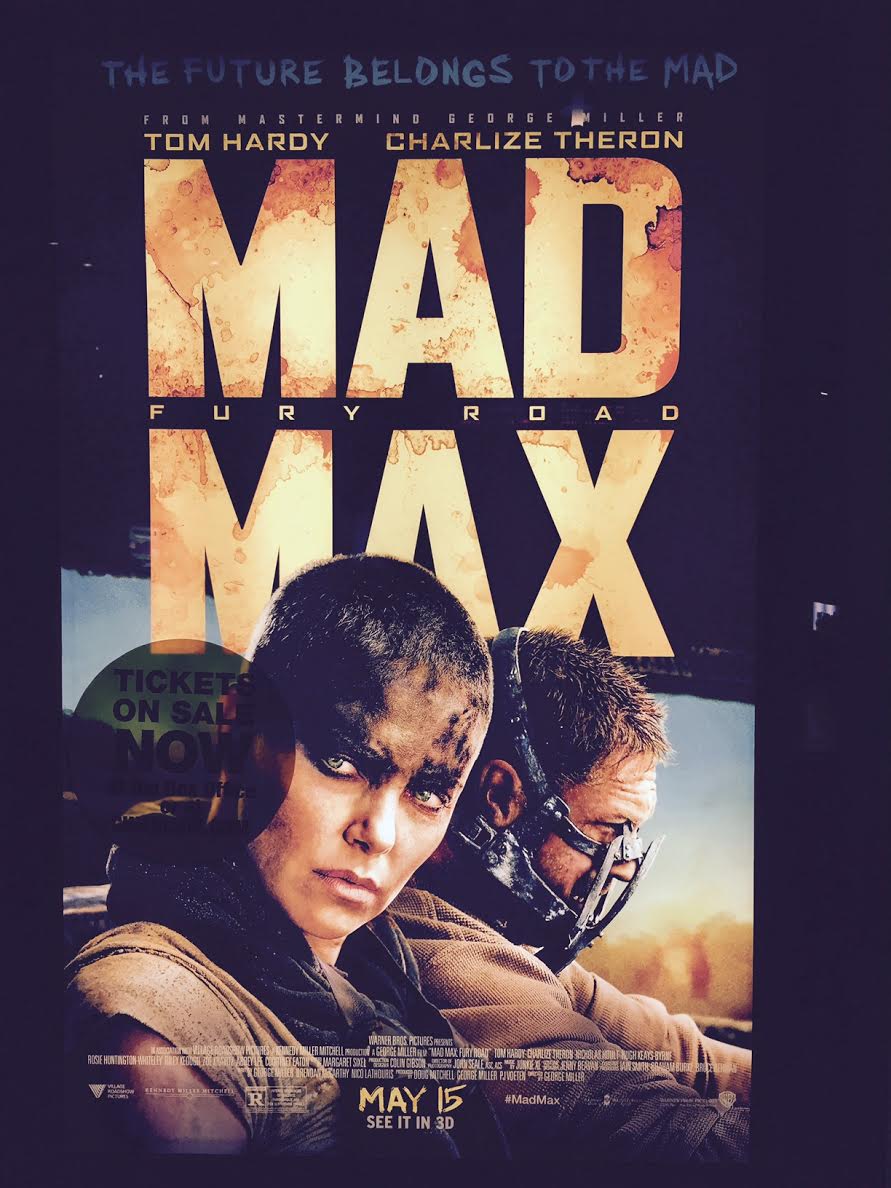
When I first saw the Mad Max trailer, I almost shuddered. I honestly thought it looked like one of the stupidest movies I'd ever seen. Inexplicable babes and dystopian car chases and apparently nothing else. Then it opened, and Steven started hinting that we might want to go see it; the internet buzz was that it was fabulous. I started softening, and agreed to watch it. We watched two of the originals first, and I'd recommend it. Anyhow, we were way behind everyone else in seeing it because parents, but if you haven't seen it yet, rent the originals off iTunes (they're like $4) and then for heaven's sake hie yourself to the movie theatre and go see this movie because it is awesome. And probably wait to read this post, because spoilers.
Visually the movie is stunning. The scenery is incredible, especially for a barren wasteland, and the prop department must've had so much fun designing the vehicles-- everything, the polecats, the hot-rod tank, the costuming, the engine-based religion, all harks back to and expands on the offbeat motorcycle-gang world introduced in the original, but taken to an epic scale.
Actually it felt like that progression in a lot of ways. The original was a (kind of awful yet oddly beautiful yet weird) very intimate story in the midst of apocalypse. No cities levelled, no epic battles, just open road and a few motorcycles and cars, really; a story about a family. The second one expanded the scale to a settlement big enough to need a bus to get around. From the looks of the trailer the third is a slightly larger world still. And then this, a handful of cities. Really, it's still quite small, Joe's territory not more than a day's journey around. But the environment got harsher, the cultures stranger, the violence broader, and Max himself more laconic and withdrawn.
It's no secret this is being hailed as a feminist film, but really what I really loved about it was it was just a great story. The women didn't feel like tokens, like cardboard cutouts, like embodied concepts about feminism, but like real humans beings with passion and resonance and variety. You know, like women actually are.
So, here I go with the breakdown:
Role of Women: In the world of the film, the women of the Citadel are breeders. The most telling line to me was just a casual comment between two of the warboys after the Five Wives are discovered to be escaped along with Furiosa: "She took a lot of his [Immortan Joe's] stuff." "What stuff?" "His breeders." Although Furiosa is entrusted with driving a war rig, most of the women we see in the Citadel are caged and controlled: the nursing mothers hooked up to constant breast pumps, the wives in their warren. In the commentary of the film, though, the women are, to quote, "not things." The moment when you first see the Wives, slender, sparsely clad and luscious, (described in the previous link as "what would happen if someone decided to heavily arm a Burberry ad"), the knee-jerk reaction is to assume they're what they look like, what they would be in almost any other action movie: eye-candy. My gut reaction was to object, as I would in any other action movie. But, of course, in the story eye candy was what they were, the role they had been forced into by nature of their lives. But the story took you beyond that. Into their loyalty, dignity, and ferocious passion to be free. Early in the movie, during the first chase into the dust storm I think it was, a war boy drops into the vehicle. The five young women, out in the rough, dark world for the first time in their lives, with no knowledge of weapons, with soft hands and long flowing hair and smooth skin, pounce on him, grabbing and biting, their drive to be free crackling across the screen. I swear, in any other movie ever those women would've been screaming and cringing. It was a beautiful moment to see onscreen. Another equally beautiful one was when the heavily-pregnant Angharad places herself and her child between the man who had owned and abused her, and the woman who was helping her escape. Her dignity in that moment was palpable. Great article that outlines a little more of this aspect here.
Sexualisation of Women: Coming out of the theatre, I was reminded of the movie Sucker Punch, the one and only movie I walked out of midway through at the theatre. It purports to be a story about young women fighting back against sexual abuse, but the moviemakers sexualised the actresses so heavily that it felt like it was spitting in its own face. Fury Road was the opposite. A story about women sexualised and abused and objectified completely by their world, who are not at all sexualised in the film. No panning shots up their legs. No suggestion that the hero is entitled to sexual access to them by virtue of helping them (see Skyfall). Even the way they were dressed, which could easily have been presented very sexually, was instead a piece of storytelling, an imposition on them from outside that didn't detract from their dignity and strength.
Bechdel Test Pass/Fail: Pass, of course.
Male:Female Ratio: The pursuers are exclusively male, and there are a lot of them, so in that sense they outnumber the females, but of the characters you get to know and connect with, females outnumber. Outnumber, yes.
Are you buying your movie tickets yet? Need more convincing? Everything here.
Still not convinced? Look at this picture of Road Warrior Mad Max and COME ON.
/cdn0.vox-cdn.com/uploads/chorus_asset/file/3700266/madmax2.jpg)
Wednesday, 27 May 2015
Women's Wednesdays: Conductors
 |
| via A Mighty Girl |
Wednesday, 20 May 2015
Writing: Conventicle, Chapter Seven
They were a
matched set now, Aldous moving east from the city in the wake of Cressus and
Vana, and Weiss moving east from the village in the wake of his own
credulousness. On horseback, Aldous was making better time than Weiss, but they
had to swing far to the north to get around the bog that had almost swallowed
up Weiss, and so for the remainder of the night the distance between them was
not much closed.
By dawn,
though, Weiss was stumbling again, slow and weary and weighted, and Cressus and
Aldous switched horses so that Aldous with her slight form could give Cressus’
mount a respite. They reached the first near the tenth bell and it was there,
tied to a tree, that they found Terrick and heard his story. Weiss, travelling
in the company of a Thron woman. Terrick was given a horse, and Aldous rode with
Cressus. She could feel the anger crackling through his skin. It was whirring
and buzzing against her chest, and she liked that, though it frightened her
too. Weiss, Weiss, what are you doing?
At about
midday, as Aldous was sharing dustbread and a flask of whiskey with Cressus,
his electric anger suddenly hardened into glass before her eyes. She followed
his gaze and saw two women travelling along the road out from the village. One
of the women wore the simple belted tunic and linen headscarf of a farm worker,
but the other was a Thron. You could see it even at that distance. Long black
braid down her back, skin even darker than the tanned skin of the village
woman. She wore a strange, loose-draped dress of deep coppery-gold, and she was
leading a village woman away from her home. Aldous barely had time to register
all this when Cressus and Vana wordlessly kicked the horses into a gallop.
Aldous was clinging to Cressus’ back but she could feel everything in him
flowing forward, reaching furiously for the Thron and her victim, and she
thought in surprise that if she fell off the horse now, Cressus would likely
not even notice.
Despite the
bright midday sun, everything felt strangely cold and crystalline. Vana was low
on the neck of her horse, a black river with her black hair and black tunic and
black knifebelt. Cressus was a mountain, an icy height, craggy and howling with
wind. Aldous shrank back into herself. They were riding to kill.
The pair
saw them dawn the road and ran, although there was nowhere to go. They ran as
animals run, zigzagging wide-eyed through the scrubby grass at the roadside,
and Vana and Cressus without speaking herded them towards the gully of a
mountain stream that crossed under the road ahead. When they had their quarry
at the edge, they both suddenly slowed to a crawl, pulling up the horses and
dismounting with a menacing, leisurely grace.
“Hello,”
drawled Vana, thumbing her knives.
Cressus’
boots crushed through the grass, and the Thron stepped to face him. She held a
wooden staff and braced it towards Cressus, but Aldous thought, “Cressus will
snap that like a twig,” and so he
did, darting forward with unexpected speed, wrenching the staff away, and
casually breaking it in two across his knee. He tossed it into the gully and said
lightly, “I’m going to enjoy this.”
The Thron
woman moved quickly, slipping in front of the village woman, and barring out
her arms as if she could somehow protect the woman from Vana’s knives and
Cressus’ bearlike arms.
“Oh, don’t
worry, we won’t kill you quite yet,” said Vana. Kill them? thought Aldous, a twist of horror contracting across her
belly, and she made a half-hopeless gesture. Vana looked pointedly at Cressus
and jerked her head back towards Aldous.
“Aldous,” murmured Cressus gently, coming
over to her side. His breath danced over her neck as he bent very close to her
ear. “Aldous, please keep quiet,” he begged. Vana’s back darted tongues of
black, disapproving fire. Aldous’ eyes were wide as a child, and she had them
locked onto Cressus’. She was holding onto him, the warm, rough skin puckered
around his eyes, the set of his shoulders. “I will be quiet,” she said. She did
not feel sorry—yet.
#
He was under the
shadow of the mountains now.
“Caethron.” Weiss said it aloud, feeling
the urgency and weight of it as Mare had said it before she parted from him.
The gate. The safehouse. Carved into the very mountain, it was a way between
where no pursuer could follow, and yet it seemed to Weiss that, wretched as he
was, it might also be a bar for him. He kept strictly to the path on the map.
The few travellers he met, he did not even acknowledge. He kept his head down,
and his feet somehow moving, one before the other, and he was under the shadow
of the mountains now.
When he came to the steps up to the
gate, broad, shallow steps roughly cut into the mountainside, he looked
foolishly up at the gate, and down at his map, and up again, and down again.
The plains and Aiken where he had lived all his life were behind him, but with
an effort he managed not to look back at it, and he breathed deeply and started
up the steps.
He did not look back when he heard the
dull thunder of horses’ hooves, the commotion of following that rummaged along
the trail behind him, did not even look back when two strange voices, one of a
woman and one a deep, booming man’s voice, called his name, growing in strength
as the horses neared, telling him to stop.
The gate between the mountains was
before him, and Weiss said, “Caethron,” in quiet wonder, and he raised his hand
in a fist to knock.
A small door slid to, opening a window
in the stone gate, and a face hovered in the opening. It was the face of a man
about forty years old, slender and lucid, and it’s owner asked gravely who was
there, and whence he came, and what did he want at Caethron.
“I am Weiss, of Aiken, looking for
passage to Jesh’s Land and to Elionae’s City beyond that. I was sent by one
called Mare to find refuge here—if you are willing to let me in.”
There were footfalls on the steps behind
him but Weiss didn’t turn; the urgency in the eyes of the man behind the gate
was enough for him, and his hands reaching out to pull Weiss in as he swung the
gate open. Weiss stumbled into the courtyard as the man slammed the gate shut
behind him, and the great iron bar of it fell with a knell of strength. On the
other side of the gate, the great man and the woman in black shouted their fury
into echoes of the mountain.
#
Back at the mouth of the pass, Aldous
paced nervously between the two women bound back-to-back on the ground, and the
horse tied to a tree. Her hands fluttered through the air, through echoes of Cressus
snapping the wooden staff like a twig, his warm skin, of Weiss grave and
determined out on the fields, the courage in the eyes of the Thron woman at her
feet, the grey bank of a thousand thousand days of her life in Aiken, and she
found herself torn down the middle, crying silently.
“Woman of Aiken,” said the Thron woman,
her voice an arrow cutting clear and straight through the mountain air, “why do
you weep?”
Monday, 18 May 2015
Music Mondays: We Go Where No One Goes, Jonsi
We go where no one goes/we slow for no one...
Found this song courtesy my three-year-old who is a big HTTYD fan. I love how this song incorporates the theme music, but mostly I'm frustrated that I will not (this side of eternity; I can always hope) get to listen to this song whilst actually flying, with or without a dragon.
Wednesday, 13 May 2015
Writing: Conventicle, Chapter Six
Chapter Four
“Mare!” Aldous jerked awake, startled to find herself in an unfamiliar place. It took her a few moments to place herself, the strange bed with its strange smell. But Cressus asleep beside her felt anything but strange. She watched him in the half-light, steadying her thoughts. It had been an unsettling dream. Weiss, falling down a steep slope on a backdrop of fire, and it had been her hands that pushed him down, and yet as he fell, instead of the dark, angry red swallowing him, golden light swept up from the valley and welcomed him. She had tried to call after him, but she felt her feet planted, her back suddenly bowed by the weight that she had borne on her back since the day she was born. No words had come.
“Mare!” Aldous jerked awake, startled to find herself in an unfamiliar place. It took her a few moments to place herself, the strange bed with its strange smell. But Cressus asleep beside her felt anything but strange. She watched him in the half-light, steadying her thoughts. It had been an unsettling dream. Weiss, falling down a steep slope on a backdrop of fire, and it had been her hands that pushed him down, and yet as he fell, instead of the dark, angry red swallowing him, golden light swept up from the valley and welcomed him. She had tried to call after him, but she felt her feet planted, her back suddenly bowed by the weight that she had borne on her back since the day she was born. No words had come.
“Just a
dream,” she told herself, but she was worried about Weiss. Cressus had promised
that Terrick would talk Weiss home, but after all, the Blind Eye was known for
their kills, not their diplomacy.
Aldous’
stirring woke Cressus, slowly, and he cupped her face in his broad hand, and
said, “It’s early.”
“I had a
dream,” she said.
“Tell me,”
he said, and as he lay on his back, listening in that deep way no one ever had
before, Aldous told him.
“It is not
your hands hurting Weiss,” said Cressus when she was done. “You’re trying to
help him.”
Aldous
nodded and tried not to wonder if it were true.
“Who is
Mare?” added Cressus after a moment.
“I don’t
know,” she replied. “It was just what he said as he was falling.”
#
She came
running up the path, breathing hard, her face set, her red dress a banner. She
clutched a staff of wood as she ran.
“You shall
not have him!” she cried, and Terrick spun to face her. The triumph that died
on his face at her cry flared up again when he saw her slight figure. Even to
Weiss, her long black braid tossed by her steps looked ridiculously childlike
as she ran, but her dress was a banner, her mouth, her eyes, and he struggled
up the slope even as the weeds and saplings he tried to anchor himself with
came up by the roots in his hands.
“Mare!” he
said, but she did not slow or look at him. She sprang at Terrick with the staff
already a blur. Terrick whipped a short sword out of a sheath at his thigh and
Weiss’s world seemed to distill down to the racket of wood against metal. His
Deedsweight pulled him down and pulled him down but he pulled up to level
ground and felt for his own long knife when the sound changed to that of wood
against flesh and bone, a dull thud, and Terrick fell. Weiss was in time to put
the knife at his throat as Mare kicked away his sword. With her staff braced
against his chest she said again, with a fierce joy, “You shall not have him.”
“Check his
arm,” she told Weiss, nodding at Terrick’s left arm, and Weiss pushed up the
sleeve to reveal a blind eye slashed top to bottom picked out in black ink on
the skin of his forearm.
“Oh,” said
Weiss in a small voice, and then he was angry.
“What is
this place?” he demanded of Terrick, but it was Mare who answered.
“Tirsin,”
she said. “Oh, Weiss, I told you to make for the pass in the mountains; how
came you to be here?” Her face was no longer a banner, but a cold rain.
“He told me
it was a safe way,” said Weiss. He was afraid again, suddenly; he knew not why,
but that there was something dark and brooding lurking in the fire beyond the
mountain.
“A safe
way? Tirsin? There is naught but death here!”
“Aye, death
and woe aplenty,” sneered Terrick suddenly. “But I’d ha’ brought you back to
your sister safe and sound alright if not for this bloody Thron’s interference.
It’s only them that won’t see reason nor surrender in a fight that I give to
the Lady,” and he cast a significant backwards glance towards the fiery
mountaintop.
“’The
Lady’? I don’t understand.”
“Let us
deal with this man first,” said Mare, “and get away from Her, and then I will
tell you.”
#
“She is
old, very old,” said Mare, “and very hungry.” Terrick was tied to a tree. Mare
had explained conscientiously that he would not be left there long—the Blind
Eye would be sure to follow his trail when he did not return to the city. “So
he won’t,” she had said, “die of exposure or hunger here.” Weiss would’ve
muttered something to the effect of ‘better if he did’ but Mare’s voice leaned
shame on his.
Now,
looking back to the mountain, Mare told him of Tirsin, the name of the mountain
and the name of she who lived inside the mountain, which in the old tongue
meant ‘Weight’. She was a dragon of the old kind, wingless and blind, stirring
up the stones, humming with fire. An open maw, waiting for souls to stumble in,
or be stumbled. All this Mare explained in a few vivid strokes that left Weiss
breathless with his narrow escape, and trembling with his weariness.
“But how
did you find me?” he asked then.
“Though
Aiken may be full of people who wish you off your path,” said Mare, “Elionae’s
wish is for you to go on, and he is not easily gainsaid. I chanced to see you
as I was leaving the village, up on the ridge as you followed that man.” And ran all the way up, thought Weiss,
disgusted with himself. He was weary and weak, but Mare had seemed strong
before. Now she, too, walked with a leaden step, and there was a long, shallow
cut along her arm. She would not let Weiss look at it.
“The Blind
Eye are tailing us now. I have one more village to go to, and I cannot stop.
When I am safe in the stronghold they will treat it; it isn’t deep. As for you,
make all speed for the pass, and beyond it—“ she pointed to his map markedly,
that, he supposed, he might not yet again part from the way—“Caethron.”
#
Aldous
passed the afternoon peacefully in Cressus’ room at the Ravenshead Inn. The
noises of the Racketeer’s Quarter—horses, bartering, coming-and-goings—were
very different from the noises of the Queen’s Quarter where Aldous lived, where
quiet murmurs prevailed, punctuated only by the marching boots of the
Geridspolice.
She had
spent the afternoon copying leaflets for Cressus in her precise, sloping hand.
It pleased her that there was something she could do for him, so much so that
she did not take much notice of the words she was copying. Precise, sloping
hateful words about the Throns, precise, sloping sneers at the Queen, at the
police for their lack of action. She savoured the rhythm of the quill and the
ink and the scratch on the paper, and as dusk began to settle, Cressus came in
and kissed her shoulder. He pulled her upright as she turned to kiss his mouth,
and for a moment she was lost in that tangle, but then he said abruptly,
“Terrick
hasn’t returned.”
“Weiss
wouldn’t…” she said at once, and then stopped because she didn’t, after all,
really know what Weiss would or wouldn’t do. Brother and stranger. “So what
happens next?” she said instead.
“Vana and I
will go find him and see what’s happened.”
“Why Vana?” It had come out as more of a whine than she'd intended, but she didn’t trust Vana.
“Why Vana?” It had come out as more of a whine than she'd intended, but she didn’t trust Vana.
“Because if
Weiss did overpower Terrick, he may not have been alone. I’ll be with her,”
said Cressus, lifting Aldous’ chin to meet her eyes. “I won’t let her hurt
him.”
“Very
well,” replied Aldous. His eyes on hers had bloomed a sudden purpose in her
chest. “But I will be with you as well.”
And so it
was that she found herself on horseback, with a black cloak and knife in her
belt, riding between Vana and Cressus out into the marshes that rustled their dark
secrets under the arch of the stars.
Subscribe to:
Posts (Atom)