Saturday, 12 September 2015
Eight Reasons I Love Screen Time
Watching this TEDTalk this afternoon was the catalyst for this post about screen time. (One of the things I appreciated about this TEDTalk is that it distinguishes between the effects of entertainment screen time vs. educational screen time. I wish there was also more research on the effect of interactive (iPhone/iPad) screen time vs passive screen time (TV). Mostly it seems to focus on TV.) Anyways, I know this isn't the usual kind of post you see about screen time, but I wanted to talk about the ways in which I think screen time is awesome. For me, it's all about quality and balance. We have a few basic boundaries (something along the lines of 'You need to stop playing iPhone now because Mummy wants to check Facebook...' and 'I WILL NOT listen to the Paw Patrol theme one more time today.') but mostly, it's not about time limits or guilt, but about a rich and varied experience. So without further ado, eight things I love about screen time:
1) Screen time is unjudgemental learning.
I'm sure not every child is this way, but I have a kid who is very reluctant to try and fail in front of people. He doesn't like guessing, he likes knowing; he resists situations where he feels he might not be able to perform or answer like he thinks he's should. And while we're working on this, both on addressing his fear of failing, and addressing the way we approach tasks to reduce the pressure on him, one of the great beauties of the screen is that he can learn without performing for anyone.
With a good educational app or TV show, there is no fear of judgement. Nobody's watching over your shoulder. Getting it wrong is ok. So when Scout Kid is using a educational app, he's not afraid to try, because he's not afraid to fail. He's much more willing to experiment, try, and test.
2) Screen time exposes kids to subjects and experiences they can't learn in real life.
Whether it's inside the human body, halfway round the world, in outer space, the distant past, or the microscopic world, screen time takes my kids to places they can't go on their own. We love watching How It's Made or BBC Planet Earth over lunch, and most of Scout Kid's favourite shows work in great exposure to the kind of things he doesn't meet in the everyday, from the wide range of STEM subjects in Curious George, to the prehistoric world of the dinosaurs, to the wild variety in the animal kingdom, to awesome heavy machinery and vehicles. We also love YouTube videos, especially for homeschooling-- it's a lot easier to get a handle on cloud formation, or light refraction, or what a ship in a bottle is, when you see it in action, versus just seeing a picture or hearing a description.
This exposure lets my kids make more connections and understand their world better; one of the things I love about when kids learn something early is that they're ready to learn the next level that much more quickly.
3) Screen time exposes kids to people they wouldn't meet in real life.
In the same way that screen time exposes kids to subjects they wouldn't get to experience otherwise, it gives them the opportunity to experience a broader, richer range of cultures, ideas, and personal experiences. Research has show that this can contribute to more empathy and positivity, and less fear and prejudice, towards those different from your family. Living and going to a church in the country, my kids aren't exposed to the kind of cultural variety they might get in the city-- although our town is growing more diverse by leaps and bounds; when I was a kid, the town was basically a 50-50 split of Dutch and Portuguese people, and the Dutch crowd hung out with the Dutch crowd, you know? I make an effort to buy race- and gender-diverse books, to speak inclusively, etc., but I know it's easy to fall into white/male default even when you're trying not to. TV shows (carefully chosen to avoid shallow or stereotypical portrayals) and YouTube videos can help normalise other perspectives and points of view, and I think that's grand.
Instagram's another great one for this. I make a point of following POC, and women doing non-stereotypical stuff, like welding and skateboarding, so that the boys are just used to seeing those images as part of the morning post-breastfeeding Instagram browse. (If you're looking for some account suggestions, or have some, hit me up in the comments!)
4) Screen time gives kids the power to connect on their own terms.
This is mainly a phone thing, I guess, although computers too, but I love seeing my kids text and Facetime family members. Scout Kid uses voice-to-text to send (admittedly garbled) messages to faraway grandparents or sends his favourite emojis to Daddy at work. Feral Kid loves to send videos of himself to people and get a video response. He talks to the video responses like they're Facetime, which is adorable. Scout Kid even knows how to find people's names in Contacts and phone them up, although I try to discourage that. One of the common criticisms of a screen-based culture is that it makes kids less social, but I think it can help as much as hurt. Through the above-mentioned channels, my kids learn phone manners, initiate social interactions, and enjoy jokes, express love, and connect across distances without needing me to prompt or manage them.
5) Screen time lets kids experiment with art.
Two things I'm thinking of specifically here, is the art of capturing and enjoying images, and of music. Scout Kid, like many toddlers, is a master selfie-taker, but he also enjoys photographing increasingly-less-blurry images of our house, his family, and weird close-up still lifes. He likes editing and filtering them, and favours black-and-white shots. Both boys love Instagram, which a Facebook friend once described as "a picture book created by the whole world that never ends." Like, heck yeah they like that, and it's a whole other ball-game than a frenetic, keep-that-kid-quiet TV show, so why lump them in together?
Scout Kid is also growing into a fine DJ, and has definite tastes. His current favourites are all what he describes as 'beating songs', a genre which encompasses hip-hop, dubstep, and good solid rock songs. I love hearing him sing beautiful, complex lyrics, instead of just typical nursery-rhyme toddler fare, and I love the questions he asks about the meanings of songs, and I love his little air drums when a favourite tunes comes up on shuffle. I'd actually love to make a mix-tape of his favourites some time; everyone wants to have Eye of the Tiger, Shut Up And Dance, Needtobreathe's Brother, Trepak from the Nutcracker, Showbread's Pachycephalosaurus, and Test Flight from How to Train Your Dragon on the same mix-tape, right?
6) Screen time powers imagination.
Narrative is where we experiment with dreams, examine values, and forge cultural values. As a writer, I love this and embrace it wherever I see it. In our culture, our myths and legends are on the big screen, not a story around a fire. Although there's beauty in stories around the fire that I don't want to diminish, I don't want to let a 'things were better in the good old days' attitude poison our experience of the truly great, hilarious, beautiful, or challenging narratives that nowadays come mostly from movies.
Visual imagination employed in reading is awesome, and we love to read here at the Parsonage. But the whole other immersive, visual world of movies, for my kids at least, seems to fire imaginations just as much. The boys have spent solid hours pretending to fly around the room to the How To Train Your Dragon soundtrack, their dreams caught on the spark of beautiful freedom in shots of soaring and sweeping dragons. Scout Kid plays Survivorman in deep, involved ways, using all his toys and books and blankets to build elaborate shelters and animal traps, hunting and building fires and collecting the rainwater from moss with concentration and fervour. It's no fun to clean up after, but that's not really the point. The point is, if you're choosing good quality narratives, whether they're on a screen or a printed page or a verbal story, they're going to power imaginations, and as long as you're keeping the variety and balance between the different types, movies can be just as powerful and play-inspiring as books.
(I also give the boys room time every day, because I think involved, alone play is a skill to be cultivated, and I think that helps...)
7) Screen time provides concrete manipulatives and chances to build on or problem solve.
Montessori math manipulatives are awesome. And so expensive. You know what I like? Apps that have Montessori math manipulatives for $3. Apps that teach patterning and give instant feedback, allowing Scout Kid to shift and experiment with arrangements. Movies that use music, visual feedback, and story to teach all the phonics sounds in two days, instead of weeks and weeks of phonics flashcards. Apps that teach coding through play. The chance to get hands-on with abstract concepts that are hard to make concrete in the real world.
8) Screen time saves parental sanity.
Look, I get the fear and guilt. It's easy to lean on screen time when you don't have the energy or the patience, and that's not always healthy. Sometimes we need to develop our own patience and our kids' patience. Sometimes we need to invest more in face-to-face time instead of easy solutions. Sometimes we need to let kids be bored so they get creative about keeping busy.
But sometimes screen time is a great compromise. Sometimes your three-year-old stayed up late every night of the weekend, but it's four o'clock and you can't put him to bed yet so you use a movie to give him downtime and keep him away from situations where his immature emotions plus exhaustion are just going to keep creating friction. Sometimes you and your partner need to invest in each other and Curious George makes a good babysitter for an hour on Sunday morning. Sometimes convenience is good, if there's other things that you also need to invest in-- other people, yourself, your partner, one kid who's particularly needy right now, your relationship with God. If my three-year-old watches a movie sometimes and sees me reading the Bible or helping a friend or putting energy into a special project, than I'm happy.
Balance. You know?

Wednesday, 9 September 2015
Homeschooling: Science: Cloud Types

Trying to get back into the swing of doing regular homeschooling activities now that the school year is started again. We do have a few regular things: weekly piano lessons with my sister + practices, weekly art lessons with my mama, daily Bible reading/memorization, reading, and practice counting (I'll post about our hundreds chart another time,) and we enjoy those, but Scout Kid really gets most excited about the special activities I plan.
So for this activity, we first spent some time learning about clouds. We read our Field Guide to Weather
 and watched a few videos on Youtube about weather and clouds, which kind of went in the extreme storm direction instead of the fluffy cloud direction, but hey, guided by his interest and all...
I needed some time to get cotton balls, so we did the rest of the activity a week later; in the intervening time we kept our eyes open for cloud types as we drove or played outside. Scout Kid is a big fan of the cumulonimbus.
Once my cotton balls arrived, we painted a poster (Scout Kid added a moon and some stars up top there) and decorated it with all the 10 main types of clouds (there are a lot more subspecies and special types.) Scout Kid added the rain to the nimbostratus and cumulonimbus clouds, and I labelled everything. There's lots more to learn, so we're excited to keep talking about it-- clouds are more interesting than I was previously aware.

Sunday, 16 August 2015
Ok Seriously
One more post on the Target gender-desegregation hoopla. Because I'm really frustrated and kind of horrified at the things people are saying.* I read this post by Matt Walsh because some of my Facebook friends 'like' his page (although I did decide to hide all posts from him in future because I need to live my life not constantly frustrated about this.) Anyways.
I have two sons who are into a broad variety of things, including dolls, construction vehicles, dance parties, and reading. I don't have a daughter, so I can't speak to what she would be like, although I remember being a little girl who loved biology (National Geographic wildlife specials all the way), fat novels, playing in the woods, and riding bikes and playing Red Rover with the neighbourhood kids. Chances are you have a similar story. You loved Barbies, climbing trees, and those foam 3D puzzles of architecture. You loved the Hardy Boys, card games, and a stuffed frog you took to bed with you every night even when you were way too old for it. None of these things was cause for much comment. Now, I'm not saying there were no problems with the expectations on kids in the past, of course, but the truth is that the toy aisle has gotten more gender-segregated in the last few decades.
The thing is this: toy gender segregation is not about biblical manhood and womanhood. It's about money. Toymakers, broadly, don't give a plugged nickel whether their toys encourage girls to be nice, pretty, and domestic, and boys to be tough, athletic, and spatial.** They do, again broadly, care about their bottom line. If you can get siblings to play with different toys, because one of the siblings is a boy and two are girls, you've just sold that many more toys. If boys and girls can't play together in groups because boys and girls don't play the same group games, you've sold that many more toys. If, however, kids can happily play group games, pretend games, building toys, et al. in non-gender-specific ways, toymakers don't get to divide their markets into smaller, more lucrative categories.
Why get into a righteous froth on behalf of toymakers' moneymaking categories? I talked a bit in my last post about how most of the toy segregations don't make sense and are actually discouraging the kinds of things we want to see in godly men and women. Let's go over it one more time. If your little girl plays with dinosaurs, wonderful-- she's cultivating a sense of joy and wonder in God's creation. If your little boy plays dolls, wonderful-- he's practicing to be the kind of father who's there, one-on-one with his kids, teaching them the truth as they stand and sit and walk. If your daughter loves hockey, perfect-- she's set on a path for enjoying the physical form she's been given, stewarding her body and health well, and learning to cooperate with others. If your son is dazzled by ballet, perfect-- he's getting set to grow into a man who appreciates the beauty and creativity of art and enjoys God's gift of music and dance as ways to praise him and communicate with each other. None of these things conflict in any way with Biblical categories of manhood and womanhood expressed within marriages and churches. None of these things have the slightest thing to do with sexual orientation or transgenderism. It's a crying shame to see people-- parents, even!-- acting as if it's somehow bad to let kids freely roam the toy aisles without a big sign insisting that what they like is for the other gender. It is also startlingly illogical. Surely letting kids like what they like is doing the precise opposite of encouraging gender confusion, by telling our little girls and boys that there are many ways to be a girl and many ways to be a boy, and in all that beautiful diversity, there is no need for one to long to be something other than what she is, something other than what he is: a unique person who loves, say, science experiments, Lego Star Wars, and paper doll kits, and is just right exactly the way they are.
*People are using words like 'sissifying' and 'pussifying' to describe this move, because A) this has anything to do with anybody being tough? and B) thanks for showing clearly with your word choice that yes, people do still think that female=weak and useless, so we DO need to break down these gender stereotypes; sorry Matt Walsh, when you say "Nobody ever said that girls can’t be strong or boys can’t be gentle" your own crowd is right there giving you the lie...)
**Which, BTW, not Biblical criteria at all. That's just culture and tradition talking.
Sunday, 9 August 2015
A Quick Crash Course...
...in why I write about gender stereotyping and feminism.
When Target makes a decision that allows kids to enjoy whatever toys they are drawn to without feeling as though they are making the 'wrong' choice, and a big crowd of people hop onto their Facebook page to tell them they are denying our God-ordained genders, kowtowing to the 'transbullies', and leading America further into the 'depraved' dark hole it's already in. GUYS. God didn't give Adam and Eve each a pile of approved toys. Kids are also not born with any particular proclivity to cars/blocks/actions figures vs. kitchen sets/baby dolls/pink dress up. None of these things are sexual. None of these things are inherently gendered. None of these things are treated in the Bible's discussion of gender, which instead focuses on things like honour, servant-heartedness, and love. Those are things I can do and be while moving heavy rocks to build a wall for my garden-- so why not a little girl playing with construction toys? Those are things my husband can do and be while cuddling our little boy before bedtime and singing him a lullaby-- so why not a little boy playing with a doll? These were things Jesus exemplified while heading up a bread and fish meal for a big crowd-- so why not a little boy playing kitchen?
What I'm getting at is, when you're upset about the breakdown of gender divides that do not exist in any way, shape, or form in the Bible, and invoking God to do it, you're doing it wrong. You're gypping a bunch of kids in the process. It hurts nobody to let kids like what they like without judgement. It will help kids, to feel free to explore and learn with a broader range of toys and games. It will help kids by letting them feel more confident in their choices and preferences. Putting extra-Biblical rules and restraints on little children is exactly the sort of thing the Bible frowns very strongly on. Unlike letting your daughter play with Avengers action figures and your son wear fairy wings, on which subject the Bible is utterly silent.
(Or maybe I just read the headline wrong, and Target actually replaced its whole toy section with a squad of evil child-corruptors handing out sexual literature? No? Then let me close with this handy flowchart:)
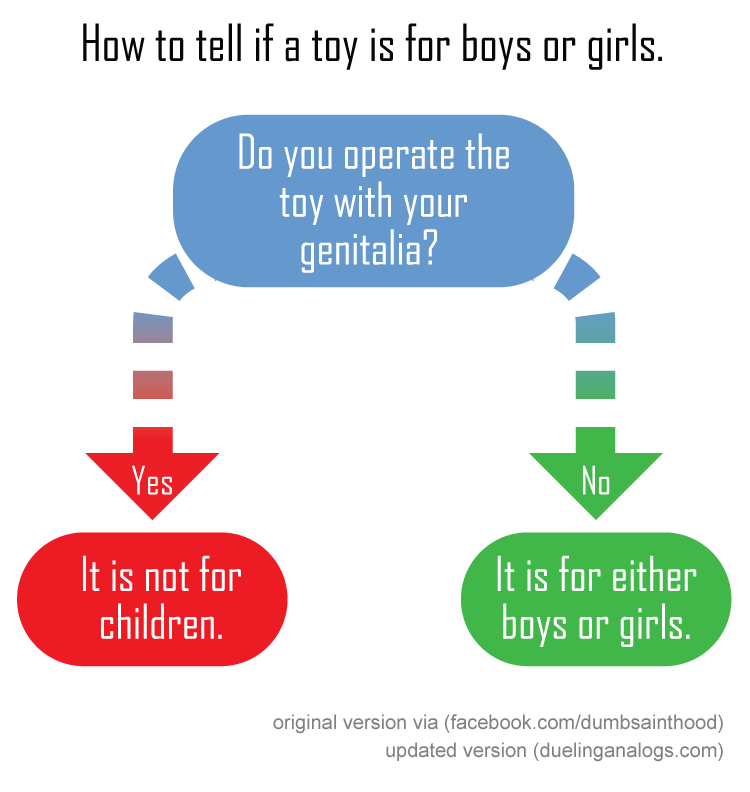
When Target makes a decision that allows kids to enjoy whatever toys they are drawn to without feeling as though they are making the 'wrong' choice, and a big crowd of people hop onto their Facebook page to tell them they are denying our God-ordained genders, kowtowing to the 'transbullies', and leading America further into the 'depraved' dark hole it's already in. GUYS. God didn't give Adam and Eve each a pile of approved toys. Kids are also not born with any particular proclivity to cars/blocks/actions figures vs. kitchen sets/baby dolls/pink dress up. None of these things are sexual. None of these things are inherently gendered. None of these things are treated in the Bible's discussion of gender, which instead focuses on things like honour, servant-heartedness, and love. Those are things I can do and be while moving heavy rocks to build a wall for my garden-- so why not a little girl playing with construction toys? Those are things my husband can do and be while cuddling our little boy before bedtime and singing him a lullaby-- so why not a little boy playing with a doll? These were things Jesus exemplified while heading up a bread and fish meal for a big crowd-- so why not a little boy playing kitchen?
What I'm getting at is, when you're upset about the breakdown of gender divides that do not exist in any way, shape, or form in the Bible, and invoking God to do it, you're doing it wrong. You're gypping a bunch of kids in the process. It hurts nobody to let kids like what they like without judgement. It will help kids, to feel free to explore and learn with a broader range of toys and games. It will help kids by letting them feel more confident in their choices and preferences. Putting extra-Biblical rules and restraints on little children is exactly the sort of thing the Bible frowns very strongly on. Unlike letting your daughter play with Avengers action figures and your son wear fairy wings, on which subject the Bible is utterly silent.
(Or maybe I just read the headline wrong, and Target actually replaced its whole toy section with a squad of evil child-corruptors handing out sexual literature? No? Then let me close with this handy flowchart:)
Sunday, 26 July 2015
Writing: Conventicle, Chapter Nine
The village,
if it might be so called, of Caethron, nestled down between the mountains in
the valley below the Gate. The houses made a little cluster, like mushrooms
sprung up overnight, with whitewashed stone walls, thatched rooves, little
gardens, and workbenches and washboards and the occasional sheep or chicken
giving them an industrious air.
“Who lives
here?” Weiss asked Hallan as they walked.
“Just a
handful of us,” shrugged Hallan. “Most of us greyheaded now but all of us glad
to serve Elionae by guarding his keep here. We are a rest for weary
travellers—a simple task but welcome, I think.”
“And I am
to meet the Interpreter?” Weiss’s curiousity had been piqued at the title, the
weight which Hallan had given the name as they set off.
“Yes. He is
a Loremaster and a wise man, and he gives all the travellers who pass through
here such lore as will be helpful to you in your journeying.”
The
Interpreter’s house was different from the other cottages, long and broad with
small windows cut at intervals in the stone. Hallan rang a bell that hung at
the door, and for many minutes, the two stood waiting on the stoop. Weiss
listening to the birdsong, the sheep bleating, the wind rustling, and tried not
to fidget. Then the door creaked open.
Hallan’s
description of ‘greyheaded’ was apt. The man and woman who greeted him matched
the mountains, granite-haired, their skin creased and scored, their features craggy. They smiled, though, with a welcome that was ageless and bright.
The woman
was dressed in a long robe, red as wine, with her grey hair wound in a crown
about her head. The man wore a pure white tunic belted at the waist, and a fur
collar. They both had a regal look, and Weiss felt very solemn.
“You bring
us a new pilgrim, Hallan?” said the Interpreter.
“This is
Weiss, lately of Aiken,” said Hallan, putting one hand on Weiss’ shoulder.
Weiss
bowed, and then was not sure if that was the done thing. It was all rather new
to him. When the Queen passed by he and his friends used to do very low,
mocking obesiances, but he had never felt so particularly awed by someone before,
and the gesture felt as ridiculous as a simple nod or handshake would’ve felt
irreverent.
“I am Seto,
called the Interpreter,” said the old man formally, “and this is my wife,
Ovesa. Please, come in.”
The room
was long and low, and the sun that shone cool and watery seemed to come in no
further than the outskirts, despite the rows of windows. Weiss followed his
host and hostess a little ways into the room, and then they turned together and
Seto said,
“Now.” His
voice reminded Weiss of the storytellers in Aiken beginnning a tale, and he
turned and saw that Hallan had not followed them in. “Weiss, lately
of Aiken,” continued Seto, “why have you come here?”
“Hallan
told me that you could tell me things that would help me along my way,” said Weiss.
He folded his hands in front of him as he spoke, and then felt like a child and
unfolded them.
Seto nodded
gravely.
“Come in,
then, traveller, and I will show you that which may help you along your way.”
Seto was
very serious, but as they walked down the long room, Ovesa turned back to Weiss
and smiled, a smile of anticipation, of reassurance, and perhaps a streak of
mischief.
Before he
could wonder what it meant, his guide stopped suddenly, between the last two
support pillars that arced up into the ceiling, and lifted the candle in his
hand.
The pillars
were painted, vivid blue and pine green and blood red, with the figure of a
man. The images were almost childlike, and yet with a depth behind them. They
showed the man clinging to the book of Elionae, pleading in the face of
destruction, overshadowed by a crown of gold.
“The Man
who is Mother,” said Interpreter. His voice was low and sacred in the dim space
and Weiss bent closer to the paintings. A thunderhead of awe began to gather
inside him.
“The Man
who is Mother, one in ten thousand,” sang Ovesa, her voice dusky-slow. “Travail
with child does he, and suckle the children he bears, the children of the
Master, unfolding the darkness to the darkened, holding the hands of the
children as the children learn to walk in the way.”
“Watch for
him,” said Seto. “Watch for him as you walk in the way.” Weiss nodded mutely.
“Now come in,” said Seto, and they passed through the door at the end of the
hall.
The next room was lit by a skylight, which shone a square of light on a painting swirling across the floor. It showed a woman, strong and smiling, bringing water to wash a room where a man swept violently, stirring thick dust into the air. The simple image was yet so vivid that Weiss’s throat tickled just to look at the spattered dust.
“Euvan, the
Grace,” said Interpreter, and Ovesa sang again:
“Thick the
dust of deeds lies upon the heart, heavy the weight. Tirsin, tirsin, the
stirring of that dust is worse than the lying of it. But here! Here the sweet
water of Euvan lays the dust, washing it away; rest she brings, and order, making
the way for the good and the great.”
“Tirsin…”
said Weiss, remembering. “Tirsin was the name of the Lady in the Mountain.”
“Tirsin,
which in the Old Tongue means ‘weight’,” said Seto. “A dragon of the old kind.
But we tell not only the fact of a thing, but the meaning of it, too. Here we
have painted the meaning of Tirsin. Soon, little brother, you will meet the
meaning also of Euvan.”
“Who makes
the pictures?” said Weiss.
“We do.
Together.”
“And
everyone comes to see them?”
Ovesa
laughed.
“For all
your beard and and sun-rough face, you are a boy yet!” was all she said.
“I’m
twenty-five,” said Weiss, a little wounded, having always considered himself
rather a hardened man of the world. And then her merriment made him laugh.
“’Tis only
that you watch everything with such wonder,” she placated him, and that made
Weiss pause. How long had he been looking for wonder and been unable to find
it?
There were
many more pictures they showed Weiss, and after took him to a pleasant sunny
room and read to him from his book while Ovesa made red-leaf tea and Seto
stoked up a fire. Weiss fell asleep in his chair listening to them read and had
a dream of a fire that would not go out, and a palace on a hill, a man in a
cage, two children waiting in a room—all vivid green and blood red and blue as
a lake in autumn.
#
“Stay low,”
hissed Mare, unnecessarily, for Arris and Aldous had already pressed themselves
flat as they could against the cold rocks. Below them, Vana and Cressus
crouched in the pass. The horses were tied up a little way’s further in, their
heads low and their ears down. It looked as though they’d been ridden all
night—from the Gate back to the place where Aldous had been guarding their
prisoners, and then back to this place in the mouth of the pass, Aldous
supposed.
Cressus’
head was low and discouraged, too, and Aldous realised he must think her
captured. Of course he wouldn’t assume she’d betrayed him. Her heart gave a
fierce twist within her, and almost she wanted to stand up, call to him to come
save her, let him believe that she had been overpowered and held captive. She
stayed low against the rocks.
The three
women had agreed to take the rougher way over the hills, instead of approaching
the Gate by the road, where they would be nearly certain of coming across Vana
and Cressus. Now it was proving to be a wise choice. They would’ve walked right
into the pair, had they taken the road.
“Move
slowly,” said Mare. “One rock dislodged could be all it takes to let them know
we’re up here.”
They began
moving along the lip of the pass in a slow, painstaking creep. Occasionally,
they had to double back to find a new path, for the steep slope above the pass
offered little in the way of cover and easy places to walk. Aldous looked
longingly at the road below.
“Couldn’t
we go down now?” she asked, when they had put Vana and Cressus behind them
around a few bends.
“Suppose
they scout up the path a little ways?” replied Mare. “As long as we’re off the
path, we might be anywhere in these mountains.”
“Not
anywhere,” Annis objected. “They must know we’re making for the Gate. If we
don’t come into the pass before long, I should think they’ll move to the Gate
itself, and they we shall have no choice but to face them.”
“We could
make better time on the road,” mused Mare.
So they
made their careful way down and, at a swift trot now, journied on. Every noise
made Aldous start, every shifting rock sounding like a horse’s hooves and every
whistle of wind the voice of a pursuer. When the Gate was in view at last,
Aldous broke into a ragged city-raised run, forging ahead of Mare and Arris for
a few strides before they fell back into step with her. Up the stairs, her legs
screaming, her side stitched, Aldous nonetheless matched her two work-hardened
companions step-for-step all the way up the stairs to the Gate. Or perhaps they
matched with her. Chest heaving, leaning against the stone wall, she wondered
if they reallly wanted her with them, their erstwhile captor slowing them down
and bringing her assassins along behind them. She hardly listened while Mare
knocked, caught in a swirl of confusion, and then as the gate swung open,
Vana’s voice cut clear and sharp across the air.
“Cressus,
Cressus, I have them!” Vana called, and Cressus thundered out from around the
bend, kicking his horse wildly to pass Vana.
“Aldous!”
he called, and Aldous froze, staring at him. He thought she was a captive. He
was coming for her. He was pouring his heart and soul into coming for her.
Dimly, she
was aware that she was alone on the step, that Mare was calling her name from
inside the gateway, but chiefly she was aware that Cressus had dismounted and
was running up the steps to her.
“Aldous!” he
said again, and she took a step back. He slowed, confused, and for the space of
two breaths his eyes held hers. She tasted in memory his sweat and desire; she
was riding beside him under starlight, dancing her fingers across the creases
around his eyes; he was listening to her, listening as no one had ever
listened. Aldous opened her mouth to speak, but there were no words. She turned
and passed through the gate, and the gatekeeper swung it closed behind her,
with a sound of iron.
That night,
after they had rested and eaten, Aldous sat alone on an outcrop of rock, watching
the gate with her knees pulled tight against her aching chest. The sky behind
the gate was crimson and orange, and somewhere down there Cressus knew she had
left him. She started at the feeling of a hand on her shoulder.
“I beg your
pardon, do I disturb you?” It was Hallan. Aldous shrugged. “I am here to care
for all the travellers that pass through here,” he said gently, “and I cannot
help but see that you mourn for something. This is meant to be a place of
refuge.”
“Aye,” said
Aldous, sudden and bitter, “and I was not meant to be here. Mare was bringing
Arris here. I was their enemy. I am the enemy. I turned my back on my lover for
the sake of something I have no part in.”
Hallan shook
his head.
“You are in
good company here,” he replied. “We none of us have any right to this refuge.”
“What do you mean?”
“What do you mean?”
“I know the
sign your lover wore on his arm,” said Hallan. He was laying something before
her, something heavy and grave. “For I myself once wore it. In those days I was
called only 'The Executioner’, the swiftest and strongest in the Blind Eye. The last Thron of many to die by my hand, he spoke aloud the words of Life even as I burnt him slowly to death.” Hallan’s
face was drawn in lines of pain and disgust, but Aldous had turned from the
gate and was hanging on his words. “I could not forget his words even
after he was burnt to ash. I could not forget. I knew I had no right to their
beauty—yet here I am, guarding the King’s gate. Nay, Jesh makes the right-- you
have only to come, traveller. Come before him shrinking that you have no part
in his kindness, but come before him bold, knowing that he has bid you come.”
Hallan pointed to the east, down past the village to where a long, straight
road stretched out between the narrow walls of the mountains. “If it’s a view
you’re looking for, try that one. That road takes you straight into Jesh’s
land, and there’ll be more joy there than can be found in a hundred lovers or
all the power in Aiken.”
Aldous
turned herself to follow his hand, and gazing down into the valley, she said, “Thank-you,”
softly. Hallan slipped away, but he left behind him a little book, bound in leather
and illuminated in gold. With her face set towards Jesh’s land, Aldous began to
read the Song of the Living.
Monday, 22 June 2015
Wednesday, 17 June 2015
Writing: Conventicle, Chapter Eight
Weiss found himself waking from a long, dreamless
sleep, into slanting sunlight in an unfamiliar room. His muddy clothes were
heaped upon the floor, strange and foreign amids the clean linen sheets, the
tall arching windows, the fluttering white drapes, and the smooth white stone
floor. Cool mountain air drifted in the windows, but Weiss was more interested
in the smells drifting in through the bedchamber’s door: rich, meaty, hearty
smells that set his stomach rumbling with an urgency that brooked no argument.
He dressed himself in a brown robe that
hung beside the bed, and despite feeling rather awkward in its loose folds, he
made his way out into the hall.
“Good morning, traveller,” said the man
from the gate last night, who was stirring pottage over a cheerful fire in the
common room. He rose to press Weiss’ hand sincerely, introducing himself as
Hallan, and then gestured him to a place at the table and served him: pottage
with red beans and mutton, thick slices of bread, cheese, and then cream and
berries, and steaming tea. Weiss ate and ate, until looking down at his place
he was suddenly quite ashamed of how much of this good man’s food he had eaten
and what poor company he had been throughout.
“Nay, nay,” said Hallan mildly when
Weiss apologized. “There’s few come through here that aren’t in need of a good
sleep and a better meal, but you looked more in need of them than most.” He
nodded in the direction of a large mirror that hung to the left of the table
and Weiss, giving his reflection the attention that had previously been fully
taken up with food, was shocked at how gaunt and dirty he looked.
“I wonder you were willing to put me in
one of your beds in this state,” he said, shaking his head.
“Sheets wash clean,” shrugged Hallan.
“And I keep the beds for travellers. Now tell me, Weiss, how came you here? Who
sent you? And what became of you on the way, that you were so worn and dirty?”
So Weiss began at the beginning, meeting
Mare on the plains, his struggle in the marsh, how Signa turned back. The man
and the mountain and the flight from the Blind Eye.
Hallan listened silently, sympathy
dancing across his face as Weiss spoke, but he interrupted once to ask, “Where
is Mare now? I’d have expected her to reach Caethron by now.”
“She said she had one more village to
visit,” said Weiss. A little knot of worry danced into the air off Hallan’s
brow, and Weiss swallowed it, and would nurse it for all the rest of the
morning and evening.
“Well, the way you’ve come by has been
the death of many, and it will be the death of many more,” said Hallan soberly
when Weiss finished his tale. “Thanks be to Elionae that you have come so far
in one piece.”
“I should never have done if not for
Mare,” said Weiss. “And I was so witless every step of the way, forgetting the
map, falling for tricks, that I am ashamed to even stand talking here. And
yet—“ he looked ‘round at Hallan earnestly—“I could not be gladder to be here.”
“Your shame need not weigh you down,”
said Hallan. “Here there is no reproach. Only help.”
Together, they passed the afternoon in
extraordinary peacefulness, drawing water from a mountain stream to warm for a
bath for Weiss, and then to wash his clothes. Standing in his room as he
readied himself to dress in his sun-dried breeches, jerkin, and cloak, Weiss
ran his palm along the strict cording of the Deedsweight where it cut into the
skin of his shoulder. Unbreakable. Everyone had always said so. Just something
to live with. And beyond through the wide stone arch of window, Caethron lay in
the valley, a little cluster of white stone houses, small amidst the crags and
grasses, and it was hope. Weiss squared his shoulders, and it was as if his
heart was running, sprinting and leaping through the open window, down, down
the rocky slope, to the village, and to what was beyond it, to the way that would
lead him—must lead him, for what else
was there?—to the Breaker of the Unbreakable Cord.
#
“They will find us, I know they will.”
Aldous said it quietly, into the scrub grass, so neither the Thron nor the farm
worker could hear. She knew she ought to sleep; it was still a few hours before
day and she could use the rest for the journey ahead. The mountains were cold,
though, and her heart was colder with fear. Vana and Cressus would’ve gone back
by now, to the spot where they had left her guarding the prisoners, and they
would’ve seen her treachery, and they would be hunting. Cressus, she thought,
might give her mercy, but Vana would not be reined in, not after this. And when
she thought of Cressus’ fierce glee, breaking the staff and binding the women
and pounding away after Weiss, she was not even sure he would give her mercy.
She shook like a leaf as she lay wrapped in her cloak, and not only for the
chill of the ground.
Yet she had not been able to say no.
Mare—that was the Thron—had asked her why she wept, and a thousand thousand
grey days had tumbled open and left Aldous’ heart bare. It was like a blind
creature from a cave, white-eyed and feeble, that husk of a heart, but Mare had
spoken balm to it. “Why stay here,” she had asked, “to steep in such misery for
the rest of your days?”
Aldous had cried. By the Queen, she had
cried harder than she could ever remember crying, till her cheeks throbbed and
the skin around her eyes was dappled red and her nose ran like a neglected
child’s, and Mare had lain patiently on the cold ground until the storm was
passed and Aldous was ready to saw the ropes loose and help Mare and Arris, the
villager, to their feet.
Her cave-creature heart had held onto
Cressus. It was still holding onto him, truth be told. Amid the roil of fear
and hope, there was a little warm nucleus of memory, his skin against hers,
their lamplit tenderness—it was clutched against her as close as his real body
had been, where no one could touch it. Yet she had betrayed him. He would
despise her.
Dawn came, greying then gilding the sky,
and Arris stirred, and woke, and began building a fire while Mare slipped off
into the brush to gather food. Aldous felt she should help, but she didn’t know
the first thing about building a fire nor foraging, so she sat awkwardly off to
the side instead.
“Come get warm,” said Arris at last,
tersely. She was older than Aldous, her skin lined and tan from her work in the
sun in a way that made Aldous’ own pale skin look almost babylike. She had kept
aloof from Aldous so far, which, considering that Aldous had been her jailer
not twelve hours ago, was fair. But now, as she fed the fire with chips of dung
from her pack, Arris made a space for Aldous, who came forward gratefully to
warm her cold-clumsy hands.
“He was quite a man,” said Arris without
introduction, and it was a question.
“I did not know he could be cruel like
that,” said Aldous plaintively, beseechingly. Arris looked back at her with
steady eyes, unyielding, and Aldous’ voice dropped into a murmur: “He was so
very kind to me,” she said.
“And now what?” said Arris. “Will he
still be kind?”
“Yes. No. I don’t know.” Aldous watched
the flames leaping up, the ash dancing across the cool white gold of the sky.
“Vana would happily kill us all, no doubt.”
“Vana would,” agreed Arris. “And what of
the man they went after?”
“My brother,” said Aldous, her heart
soft and sick suddenly. “I don’t know. Vana wasn’t sure they’d be in time to
catch him at the gate. I can only hope. I expect they’d kill him after what
he’s done—they were only going to keep him alive for my sake.”
“They were not in time,” said Mare,
coming up behind them. “I do not think they could’ve been, for I saw the
purpose in his eyes when last I was with him, and he would’ve moved sure and
fast. And I do not believe Elionae would let him die so near the haven.”
“What could Elionae do?” asked Aldous,
half-hopeful, half-suspicious.
“His hand is in all, though we may not
see it,” said Mare. “Hallan was keeping the gate and he would’ve seen Weiss in
safely. I just do not think they were in time.”
She was comforting, her smile, her
hands, her voice, in a way that was peculiar for the youngest of the group.
Mare looked closer Weiss’ age, perhaps twenty-four, and yet Aldous at
twenty-eight and Arris, who must be into her thirties, were drawing from her,
turning their faces to her as new seedlings follow the sun.
Mare spread a leather roll before the
fire, in which was dried meat, and dustbread. Beside it she deposited cress,
and breadroot, and mushrooms, nuts, and a handful of round blue-black berries
Aldous didn’t recognize.
“Eat well, sisters,” she said, “We’ve a
race ahead of us before we’re safe in Caethron.”
Aldous
plucked, half-unconsciously, at the black cord of the Deedsweight that cut,
taut as a bowstring, the baby-white skin of her shoulder.
Friday, 5 June 2015
Film Fridays: Mad Max: Fury Road

When I first saw the Mad Max trailer, I almost shuddered. I honestly thought it looked like one of the stupidest movies I'd ever seen. Inexplicable babes and dystopian car chases and apparently nothing else. Then it opened, and Steven started hinting that we might want to go see it; the internet buzz was that it was fabulous. I started softening, and agreed to watch it. We watched two of the originals first, and I'd recommend it. Anyhow, we were way behind everyone else in seeing it because parents, but if you haven't seen it yet, rent the originals off iTunes (they're like $4) and then for heaven's sake hie yourself to the movie theatre and go see this movie because it is awesome. And probably wait to read this post, because spoilers.
Visually the movie is stunning. The scenery is incredible, especially for a barren wasteland, and the prop department must've had so much fun designing the vehicles-- everything, the polecats, the hot-rod tank, the costuming, the engine-based religion, all harks back to and expands on the offbeat motorcycle-gang world introduced in the original, but taken to an epic scale.
Actually it felt like that progression in a lot of ways. The original was a (kind of awful yet oddly beautiful yet weird) very intimate story in the midst of apocalypse. No cities levelled, no epic battles, just open road and a few motorcycles and cars, really; a story about a family. The second one expanded the scale to a settlement big enough to need a bus to get around. From the looks of the trailer the third is a slightly larger world still. And then this, a handful of cities. Really, it's still quite small, Joe's territory not more than a day's journey around. But the environment got harsher, the cultures stranger, the violence broader, and Max himself more laconic and withdrawn.
It's no secret this is being hailed as a feminist film, but really what I really loved about it was it was just a great story. The women didn't feel like tokens, like cardboard cutouts, like embodied concepts about feminism, but like real humans beings with passion and resonance and variety. You know, like women actually are.
So, here I go with the breakdown:
Role of Women: In the world of the film, the women of the Citadel are breeders. The most telling line to me was just a casual comment between two of the warboys after the Five Wives are discovered to be escaped along with Furiosa: "She took a lot of his [Immortan Joe's] stuff." "What stuff?" "His breeders." Although Furiosa is entrusted with driving a war rig, most of the women we see in the Citadel are caged and controlled: the nursing mothers hooked up to constant breast pumps, the wives in their warren. In the commentary of the film, though, the women are, to quote, "not things." The moment when you first see the Wives, slender, sparsely clad and luscious, (described in the previous link as "what would happen if someone decided to heavily arm a Burberry ad"), the knee-jerk reaction is to assume they're what they look like, what they would be in almost any other action movie: eye-candy. My gut reaction was to object, as I would in any other action movie. But, of course, in the story eye candy was what they were, the role they had been forced into by nature of their lives. But the story took you beyond that. Into their loyalty, dignity, and ferocious passion to be free. Early in the movie, during the first chase into the dust storm I think it was, a war boy drops into the vehicle. The five young women, out in the rough, dark world for the first time in their lives, with no knowledge of weapons, with soft hands and long flowing hair and smooth skin, pounce on him, grabbing and biting, their drive to be free crackling across the screen. I swear, in any other movie ever those women would've been screaming and cringing. It was a beautiful moment to see onscreen. Another equally beautiful one was when the heavily-pregnant Angharad places herself and her child between the man who had owned and abused her, and the woman who was helping her escape. Her dignity in that moment was palpable. Great article that outlines a little more of this aspect here.
Sexualisation of Women: Coming out of the theatre, I was reminded of the movie Sucker Punch, the one and only movie I walked out of midway through at the theatre. It purports to be a story about young women fighting back against sexual abuse, but the moviemakers sexualised the actresses so heavily that it felt like it was spitting in its own face. Fury Road was the opposite. A story about women sexualised and abused and objectified completely by their world, who are not at all sexualised in the film. No panning shots up their legs. No suggestion that the hero is entitled to sexual access to them by virtue of helping them (see Skyfall). Even the way they were dressed, which could easily have been presented very sexually, was instead a piece of storytelling, an imposition on them from outside that didn't detract from their dignity and strength.
Bechdel Test Pass/Fail: Pass, of course.
Male:Female Ratio: The pursuers are exclusively male, and there are a lot of them, so in that sense they outnumber the females, but of the characters you get to know and connect with, females outnumber. Outnumber, yes.
Are you buying your movie tickets yet? Need more convincing? Everything here.
Still not convinced? Look at this picture of Road Warrior Mad Max and COME ON.

Wednesday, 27 May 2015
Women's Wednesdays: Conductors
 |
| via A Mighty Girl |
Subscribe to:
Posts (Atom)